Agni and the Vedas Take Bodily Form
Bala Kanda, Doha 323
Doha 323 · Movement 3 of 3
Keep this contemplation
Preserve, print, or share
When the homa begins, Agni himself takes visible form within the sacrificial fire and receives each offering with supreme delight.
The Vedas enter disguised as Brahmins. What is ordinarily preserved as sacred sound now stands bodily in the mandap and pronounces the proper marriage rites.
Element and revelation come personally to serve the union. Fire is not a passive witness, nor scripture a distant authority consulted from memory. Both become present participants, joyful to fulfil their deepest purpose around Sita and Ram. The ceremony reveals itself as a meeting point where cosmic principles accept human form just as the divine bride and bridegroom have done.
Fire receives the offerings with a body, and scripture speaks the wedding law through living mouths.
Read the passage from the Manas
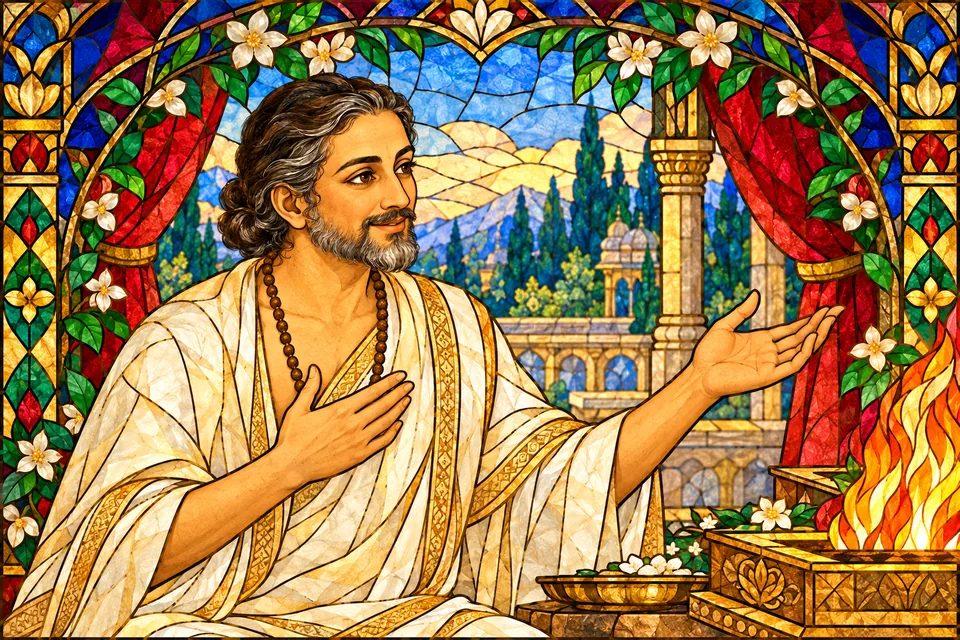
AI-created devotional illustration · Doha 323
Complete doha323 and primary Hindi PDF307; one representative Veda in human Brahmin guise teaching, all plural forms and embodied Agni in metadata.
Source reference and artistic choices
Gita Press code81 undated · PDF pages 307 · printed pages 305. Reader passage: bala-kanda-doha-324. Printed numbering may differ.
Source facts
- Agni takes bodily form at homa and joyfully receives OBLATIONS; he does not taste sacred flame.
- ALL VEDAS take HUMAN BRAHMIN GUISE and explain wedding rites; not merely bless a name.
Artistic choices
- PASS E03 stained glass: one adult human teacher head, two arms/two own hands. Actual RIGHT hand at heart and LEFT open teaching gesture, mirror opposite prompt; eyes RIGHT, gently parted joy smile. Warm golden-brown oval, short grey-brown beard, salt-and-pepper low bun, bare unmarked forehead, ivory/gold robe wooden beads. Small foreground homa fire and ONE shallow vessel added by output; flame itself is not certification of bodily Agni. Lower body cropped, no whole Veda-representative census.
- Exact poses/gazes/numericalages/clothes/ornamentcounts/geargeometryfastening/materials/spatialframing artistchoices not history or wholeparticipant/anatomy/motion/audible/emotionmotive census. Fullsourceoffcrop facts retained noabsenceinference/corpuscorrection/inventedHindi/publishing. Source comparisons/characterinsults/threats not physicaltransformations/violentevents.
- First anonymous human Veda-representative artist appearance convention; not Vasishta, Vishvamitra or a specific historically authenticated priest. Human guise does not require literal book bodies.
- Observed foreground flame is a ritual context detail, not a substitute claim that source Agni was merely fire. No original absence inference.
An imaginative interpretation, not a historical portrait or documentary evidence.
होम समय तनु धरि अनलु अति सुख आहुति लेहिं। बिप्र बेष धरि बेद सब कहि बिबाह बिधि देहिं।।323।।
At the time of the homa, Agni himself took bodily form and received the oblations with supreme joy. Donning the guise of Brahmins, all the Vedas appeared and proclaimed the proper rites of marriage.