The Heart Loves Where It Finds Rest
Bala Kanda, Doha 80
Doha 80 · Movement 2 of 2
Keep this contemplation
Preserve, print, or share
The argument places Mahadeva as a house of faults and Vishnu as the dwelling of every virtue. By ordinary comparison, the choice should require no further thought.
Yet love does not move by inventory. The heart longs for the one in whom it finds rest, and no catalogue of another's excellence can redirect that inward recognition.
This does not make virtue meaningless. It reveals that Parvati's bond with Shiva lies deeper than preference. Her mind has returned to its own source, and desire now belongs wholly to where that return has occurred.
Every virtue is named elsewhere, yet Parvati's heart rests only in Shiva.
Read the passage from the Manas
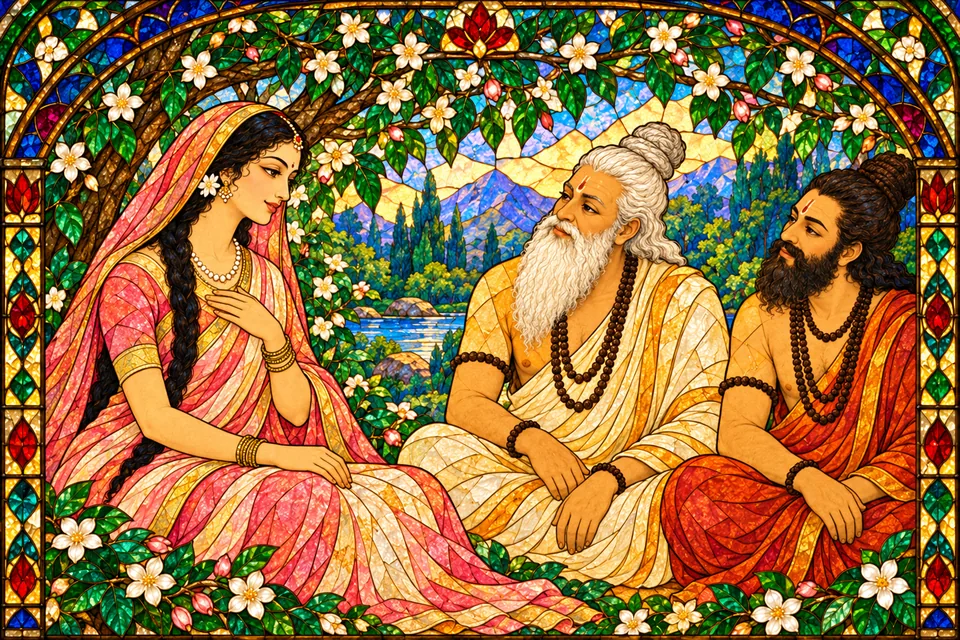
AI-created devotional illustration · Doha 80
Uma replies about where her mind rests, with a gentle hand at her chest, while two representative sages listen.
Source reference and artistic choices
Gita Press code81 undated · PDF pages 98 · printed pages 96. Reader passage: bala-kanda-doha-081. Printed numbering may differ.
Source facts
- Parvati replies, granting Shiva/Vishnu comparison for argument while affirming that the one in whom the mind delights matters to that person
- The adjacent witness establishes Parvati as speaker, not sages conceding the argument
Artistic choices
- Approved imaginative Uma and two representative sages' appearances reused, other five outside crop; Uma hand lightly on upper chest and gentle speaking face, sages neutral attentive resting hands, floral glass/forest/stream/mountains added
- No literal gods/virtue-flaw tableau, heart symbol, Brahma/Earth consolation or realized wedding; precise faces/ages/poses imaginative
An imaginative interpretation, not a historical portrait or documentary evidence.
महादेव अवगुन भवन बिष्नु सकल गुन धाम। जेहि कर मनु रम जाहि सन तेहि तेही सन काम।।80।।
Mahadeva is the abode of faults; Vishnu is the dwelling-place of every virtue. Yet the heart loves whom it loves. One's longing rests with whomever the mind delights in.