Can the Formless Walk as a Man?
Bala Kanda, Doha 50
Doha 50 · Movement 2 of 2
Keep this contemplation
Preserve, print, or share
Sati turns the attributes of Brahman within her mind: all pervading, stainless, unborn, beyond the senses, desireless, indivisible, and unknown in fullness even to the Vedas. Such Reality cannot be enclosed by any boundary.
Before her memory stands a man in forest clothing, grieving for his wife. Can the limitless truly take a body and become human? The question rises because she imagines form as a prison rather than a freely chosen revelation.
The nirguna and saguna appear to face each other across an impossible distance. Sati cannot yet see that the distance exists only within her understanding.
The forest form and the formless Absolute stand divided inside Sati's thought.
Read the passage from the Manas
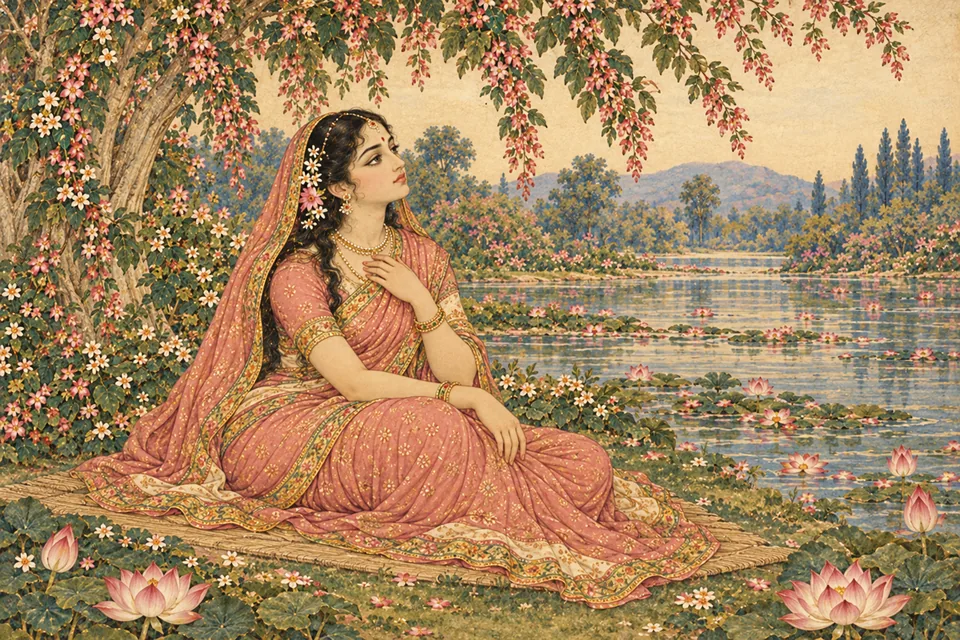
AI-created devotional illustration · Doha 50
Sati sits thoughtfully beneath flowering branches, evoking her inward doubt about the Lord's human form.
Source reference and artistic choices
Gita Press code81 undated · PDF pages 74 · printed pages 72. Reader passage: bala-kanda-doha-051. Printed numbering may differ.
Source facts
- Sati questions whether all-pervading, pure, unborn, desireless, beyond-sensory and undivided Brahman can take human form, unknown even to Vedas
Artistic choices
- Representative inwardly pondering Sati portrait, without depicting an answer or test
- Conventional female appearance is applied to Sati daughter of Daksha; no Parvati identity asserted
- Pink sari and veil, jewellery, pose, hand on chest, mat, flowering bough, river, lotus flowers and hills imagined
An imaginative interpretation, not a historical portrait or documentary evidence.
ब्रह्म जो व्यापक बिरज अज अकल अनीह अभेद। सो कि देह धरि होइ नर जाहि न जानत वेद।। 50।।
Can that Brahman who is all-pervading, stainless, unborn, beyond the reach of the senses, desireless, and without division, that One whom even the Vedas cannot fully know, can He take on a body and become a mortal being?