Joy Overflows the Walls of Dasharatha's Palace
Bala Kanda, Chaupai 294
Doha 297 · Movement 1 of 2
Keep this contemplation
Preserve, print, or share
Groups of women gather in fresh garments, radiant as lightning, with moon-like faces and eyes of young deer. Their auspicious songs are so sweet that cuckoos would fall silent from shame.
Within Dasharatha's palace, beautiful ritual objects gleam and countless instruments sound. Bards recite praise in one place, Brahmins chant the Veda in another, and women weave the names of Sita and Ram through wedding song.
The celebration is greater than the building meant to contain it. Joy presses through chambers, doors, terraces, and courtyards as though the palace has become too small and delight must flow in all four directions. Architecture yields before feeling, and Ayodhya itself becomes the larger royal house.
The palace cannot contain the names of Sita and Ram, so celebration spills into every direction.
Read the passage from the Manas
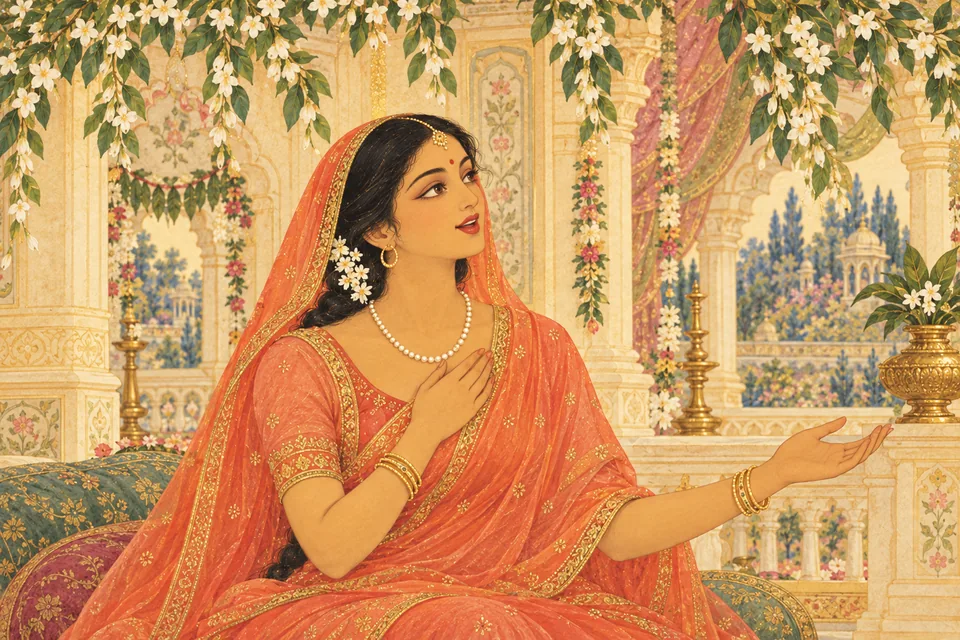
AI-created devotional illustration · Chaupai 294
Full eight couplets PDF283; selects one anonymous adult woman among groups singing auspicious Rama/Sita songs in decorated Ayodhya palace.
Source reference and artistic choices
Gita Press code81 undated · PDF pages 283 · printed pages 281. Reader passage: bala-kanda-chaupai-294. Printed numbering may differ.
Source facts
- Groups women adorned navsapta sixteen adornments, shining like lightning.
- Moon-faced fawn-eyed women dispel Rati's pride, not Rati bodily transformation.
- Women sing beautiful auspicious songs, cuckoo shamed by comparison.
- Dasharatha palace has world-enchanting pavilion; source no named Vishvakarma builder.
- Beautiful auspicious articles and many kettledrums.
- Bards recite praise; Brahmins chant Vedas, distinct actors.
- Women sing auspicious songs naming Rama and Sita.
- Immense joy, palace feels small as if overflowing four directions; metaphor not literal flood.
Artistic choices
- One anonymous adult woman head two connected arms two own hands: actual ownRIGHT upperchest, ownLEFT open upward toRIGHT. Actual OPENeyesUPRIGHT and gently PARTED redlips, not requested LEFT. Warm mediumgoldenbrown oval blacksidepart lowbraid coralorange goldveil pearls redbindi goldhoopsbangles foreheadornament, new small whiteflowercluster atlowbraid artist adornment, no received headgarland or Sita historicalidentity. Seated partial lowerbody no feet certification. Antique miniature floral bough creamstone arch detailed textile, source plural other singers offcrop no census.
- Exact poses/gazes/numericalages/clothes/ornamentcounts/geargeometryfastening/materials/spatialframing artistchoices not history or wholeparticipant/anatomy/motion/audible/emotionmotive census. Fullsourceoffcrop facts retained noabsenceinference/corpuscorrection/inventedHindi/publishing. Source comparisons/characterinsults/threats not physicaltransformations/violentevents.
- Decorative white flowercluster near lowbraid not source named received-garland identity, no exact sixteen-item enumeration. Gaze/gesture actualRIGHT differs promptLEFT and source does not specify direction.
An imaginative interpretation, not a historical portrait or documentary evidence.
जहँ तहँ जूथ जूथ मिलि भामिनि। सजि नव सप्त सकल दुति दामिनि।। बिधुबदनीं मृग सावक लोचनि। निज सरुप रति मानु बिमोचनि।। गावहिं मंगल मंजुल बानीं। सुनिकल रव कलकंठि लजानीं।। भूप भवन किमि जाइ बखाना। बिस्व बिमोहन रचेउ बिताना।। मंगल द्रब्य मनोहर नाना। राजत बाजत बिपुल निसाना।। कतहुँ बिरिद बंदी उच्चरहीं। कतहुँ बेद धुनि भूसुर करहीं।। गावहिं सुंदरि मंगल गीता। लै लै नामु रामु अरु सीता।। बहुत उछाहु भवनु अति थोरा। मानहुँ उमगि चला चहु ओरा।।
Here and there, groups of beautiful women gathered together, adorned in fresh garments, all radiant as lightning. With moon-like faces and eyes like young fawns, they seemed as though Rati herself had forsaken her own form to become them. They sang auspicious songs in voices so melodious that even the sweet-throated cuckoos felt ashamed. How can one describe the king's palace? The Enchanter of the universe Himself had fashioned this canopy of splendor. Various beautiful auspicious articles were displayed, and countless musical instruments resounded gloriously. Somewhere bards and panegyrists (bandijana) were reciting praises; elsewhere, learned priests (bhusura) were chanting Vedic hymns. Beautiful women sang auspicious songs, repeatedly invoking the names of Rama and Sita. The celebration was immense, but the palace seemed far too small, as though the joy itself was overflowing in all four directions.