Only a Brahmin's Curse Can Reach Him
Bala Kanda, Chaupai 165
Doha 165 · Movement 1 of 2
Keep this contemplation
Preserve, print, or share
Ekatanu grants the impossible request, then introduces one difficult condition. Death will lower its head at Pratapbhanu's feet, and no force can destroy him except the spiritual power of a brahmin family.
Brahmins stand superior through tapasya, the false sage says, and no protector can shield one from their wrath. If the king honours them all, even Brahma, Vishnu, and Shiva will come under his command. With both arms raised, Ekatanu declares that enmity with the brahmin community alone must be avoided.
Without their curse, destruction can never come. Pratapbhanu rejoices, believing danger reduced to one manageable boundary. By the hermit's grace, every time ahead appears auspicious, and immortality seems secured through policy.
Death bows before the king, while one unseen curse remains standing beyond the throne.
Read the passage from the Manas
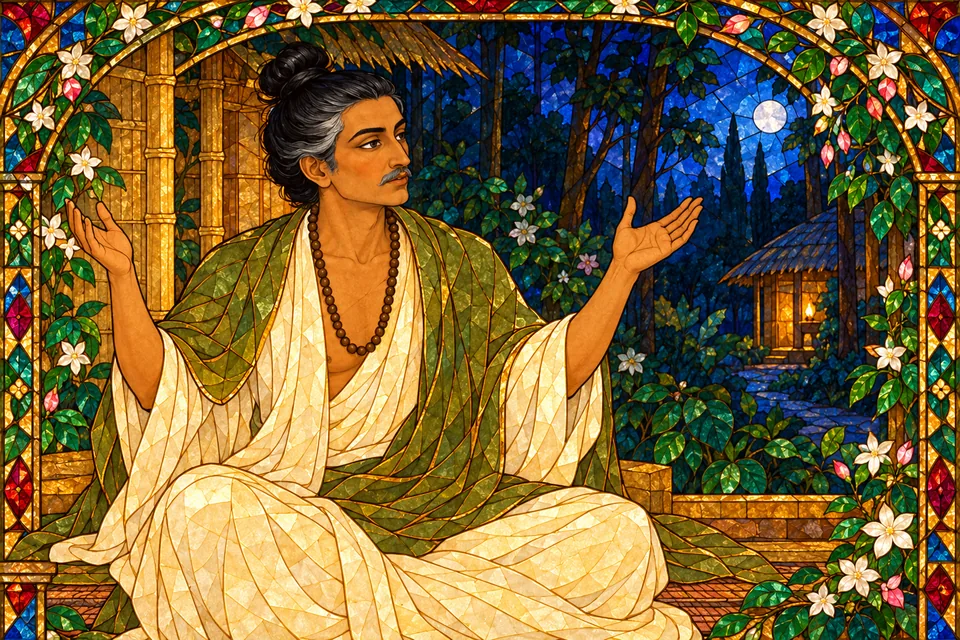
AI-created devotional illustration · Chaupai 165
False ascetic raises BOTH arms as he asserts truth
Source reference and artistic choices
Gita Press code81 undated · PDF pages 171 · printed pages 169. Reader passage: bala-kanda-chaupai-165. Printed numbering may differ.
Source facts
- All eight parts read: false ascetic claims so shall it be, time bows except Brahmin clan; Brahmin tapas and anger, if Brahmins controlled Trinity controlled are HIS claims, not universal theology or actual miracles.
- Part5 force cannot prevail against Brahmin community; says truth raising BOTH arms. Without Brahmin curse no destruction HIS claim; King's subsequent joy and welfare trust not actual immunity proof. Witness बस vs queue सब retained.
Artistic choices
- Approved C158 false former king imagined face age dress; seated bamboo hut, floral glass arch, moon and night palette artistic not historical site.
- Both arms raised with open palms, no additional hands on knees; no literal time bowing, Brahmins or deities controlled.
An imaginative interpretation, not a historical portrait or documentary evidence.
कह तापस नृप ऐसेइ होऊ। कारन एक कठिन सुनु सोऊ।। कालउ तुअ पद नाइहि सीसा। एक बिप्रकुल छाड़ि महीसा।। तपबल बिप्र सदा बरिआरा। तिन्ह के कोप न कोउ रखवारा।। जौं बिप्रन्ह सब करहु नरेसा। तौ तुअ बस बिधि बिष्नु महेसा।। चल न ब्रह्मकुल सन बरिआई। सत्य कहउँ दोउ भुजा उठाई।। बिप्र श्राप बिनु सुनु महिपाला। तोर नास नहि कवनेहुँ काला।। हरषेउ राउ बचन सुनि तासू। नाथ न होइ मोर अब नासू।। तव प्रसाद प्रभु कृपानिधाना। मो कहुँ सर्ब काल कल्याना।।
The ascetic said: O king, so it shall be. But hear one hard condition. Even Kaala, Time itself, will bow its head at your feet. Only the community of Brahmins is the exception, O lord. (kaha taapasa nripa aisehi hou. kaarana eka kathina sunu sou. kaalau tua pada naaihi seesaa. eka biprakula chhaadai kai eesaa.)