When Dharma's Bridge Begins to Break
Bala Kanda, Chaupai 121
Doha 121 · Movement 1 of 2
Keep this contemplation
Preserve, print, or share
Shiva asks Girija to hear the beautiful accounts sung openly in Veda and scripture. No single measure can contain the reasons Hari descends. Ram lies beyond intellect, mind, and speech, so saints, sages, Puranas, and Vedas each tell what their own vision can receive. Shiva too will offer the portion made clear within him.
A pattern appears across the ages. Dharma declines. Arrogant demons multiply, gathering power until cruelty becomes ordinary and injustice can scarcely be spoken. Brahmins, cows, gods, and the earth bear the pressure. Sacred order trembles like a bridge whose stones are being torn from the river one by one.
Then compassion assumes form. The Lord enters the conditions of the threatened world, not because the infinite has become bound, but because the suffering of the righteous calls forth his protection. Many forms arise from the one inexhaustible mercy.
As the bridge of dharma trembles, the formless Lord steps toward birth.
Read the passage from the Manas
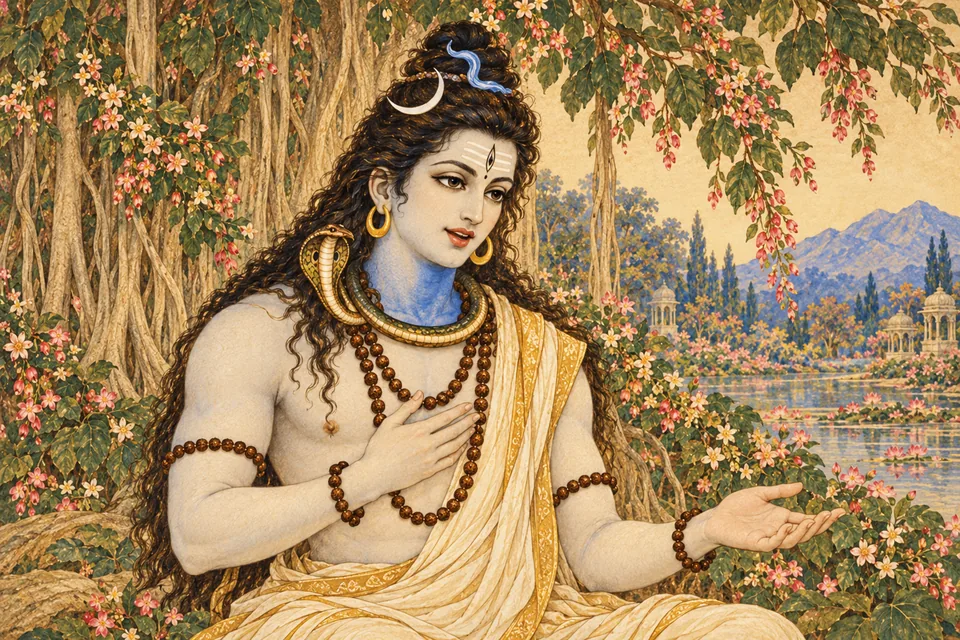
AI-created devotional illustration · Chaupai 121
Shiva's speaker-qualified as-understood explanation portrait
Source reference and artistic choices
Gita Press code81 undated · PDF pages 135 · printed pages 133. Reader passage: bala-kanda-chaupai-121. Printed numbering may differ.
Source facts
- Shiva says Rama beyond reasoning/intellect/mind/speech as his opinion
- Nevertheless as saints/sages/Vedas/Puranas say through their own inference, he tells Uma the causes as understood by him; no definitive only-one-cause or numerical amount asserted
Artistic choices
- Approved D107 soloivoryash Shiva blue only throat/crescent/Ganga short symbolicwave/serpent/rudraksha/cream drape reused; exactfaces/age/gestures/cloth artistconventions unauthenticated
- Solo upright speakingwaistportrait handownchest and lowopen explanatorypalm, Uma listener adjacentoutsidechosenframe notclaimabsent; sourcepleasantface address remains speech
- Banyanroots/floralbough/mountain/pavilion/water exact artistsettingunauthenticated; no actual sageassembly/cosmicform or later avatars/demonviolence/protection scenes
An imaginative interpretation, not a historical portrait or documentary evidence.
सुनु गिरिजा हरिचरित सुहाए। बिपुल बिसद निगमागम गाए।। हरि अवतार हेतु जेहि होई। इदमित्थं कहि जाइ न सोई।। राम अर्तक्य बुद्धि मन बानी। मत हमार अस सुनहि सयानी।। तदपि संत मुनि बेद पुराना। जस कछु कहहिं स्वमति अनुमाना।। तस मैं सुमुखि सुनावउँ तोही। समुझि परइ जस कारन मोही।। जब जब होइ धरम कै हानी। बाढहिं असुर अधम अभिमानी।। करहिं अनीति जाइ नहिं बरनी। सीदहिं बिप्र धेनु सुर धरनी।। तब तब प्रभु धरि बिबिध सरीरा। हरहि कृपानिधि सज्जन पीरा।।
Listen, Girija, to the beautiful deeds of Hari, which the Vedas and the Agamas have sung in luminous and abundant detail. The reason for Hari's avatara, no one can declare with certainty, saying 'this alone is the cause.' His descent into the world springs from mysteries beyond the reach of any single telling.