When Shiva's Faults Become Virtues
Bala Kanda, Chaupai 69
Doha 69 · Movement 1 of 2
Keep this contemplation
Preserve, print, or share
Narada offers one path through the prophecy. The husband he described will certainly come to Uma, and every troubling quality in that portrait belongs unmistakably to Shiva. If the marriage is made with Shankara, the same features that frightened the household will be honoured as signs of his greatness.
Hari rests upon a serpent, yet wisdom sees no defect in the divine couch. Sun and fire consume whatever reaches them without becoming impure. Ganga receives clean and unclean water, yet no one calls the sacred river defiled.
The mighty Lord is not altered by what would bind an ordinary being. Ash, nakedness, solitude, and the cremation ground become auspicious because Shiva wears them in freedom. The remedy is not to change the prophecy, but to recognize the divine one whom it has already named.
The ash remains ash, yet upon Shiva it shines more brightly than a royal jewel.
Read the passage from the Manas
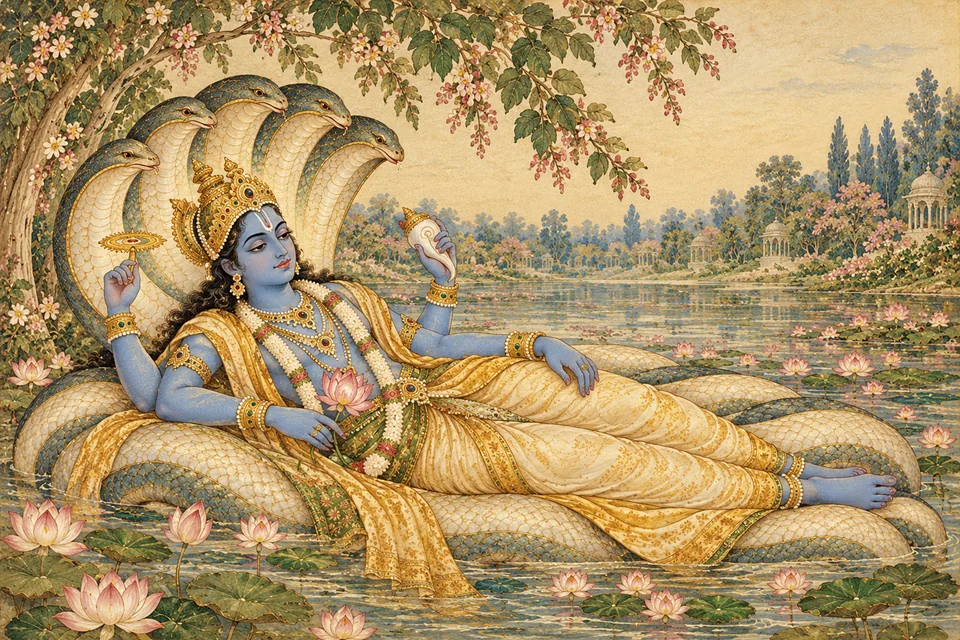
AI-created devotional illustration · Chaupai 69
An iconic Hari reclining on a serpent couch evokes the source comparison; four-arm attributes and the serpent canopy are conventional additions.
Source reference and artistic choices
Gita Press code81 undated · PDF pages 89 · printed pages 87. Reader passage: bala-kanda-chaupai-069. Printed numbering may differ.
Source facts
- The source comparison says that when Hari reclines on a serpent bed the wise find no fault; selected image evokes that comparison within Narada's explanation
Artistic choices
- Single Hari/Narayana comparison, not literal appearance in Narada's court or a future marriage
- Approved conventional Narayana appearance reused: four arms, conch/discus/lotus, gold crown, tilak, yellow/cream drapery, Shesha couch and selected five-hood canopy are iconographic additions
- Reclining pose, water plane without a source-specified ocean identity, lotus flowers, bough and soft horizon added
An imaginative interpretation, not a historical portrait or documentary evidence.
तदपि एक मैं कहउँ उपाई। होइ करै जौं दैउ सहाई।। जस बरु मैं बरनेउँ तुम्ह पाहीं। मिलहि उमहि तस संसय नाहीं।। जे जे बर के दोष बखाने। ते सब सिव पहि मैं अनुमाने।। जौं बिबाहु संकर सन होई। दोषउ गुन सम कह सबु कोई।। जौं अहि सेज सयन हरि करहीं। बुध कछु तिन्ह कर दोषु न धरहीं।। भानु कृसानु सर्ब रस खाहीं। तिन्ह कहँ मंद कहत कोउ नाहीं।। सुभ अरु असुभ सलिल सब बहई। सुरसरि कोउ अपुनीत न कहई।। समरथ कहुँ नहिं दोषु गोसाई। रबि पावक सुरसरि की नाई।।
Yet I offer one remedy, if Providence lends its favor. The husband I have described to you can be won only through japa, tapas, and vrata (chanting, austerity, and sacred vows).