Crows Become Cuckoos
Bala Kanda, Chaupai 3
Sortha 3ख · Movement 1 of 2
Keep this contemplation
Preserve, print, or share
The transformation appears before the water has dried. A crow opens its beak and the forest hears the song of a cuckoo. A heron lifts from the marsh in the purity of a swan. Tulsidas asks the listener not to marvel, for holy company has overturned harder destinies than these.
Valmiki, Narada, and Agastya stand as witnesses, each bearing a life changed by sacred association. Across water, earth, and sky, whatever wisdom, honour, spiritual movement, prosperity, or goodness has arisen can be traced to the company that awakened it. Without satsang, discrimination does not dawn, and satsang itself arrives through Ram's grace.
A base metal touches the philosopher's stone and takes on beauty. The wicked may be reformed. The good, even when thrown among corrupting influences, can preserve their native lustre like the jewel carried by a serpent. Brahma, Vishnu, Shiva, poets, and scholars hesitate before the magnitude of this glory. Tulsidas confesses that he is a vegetable seller asked to appraise a gem.
From an ordinary branch, the transformed bird releases a song no crow had known.
Read the passage from the Manas
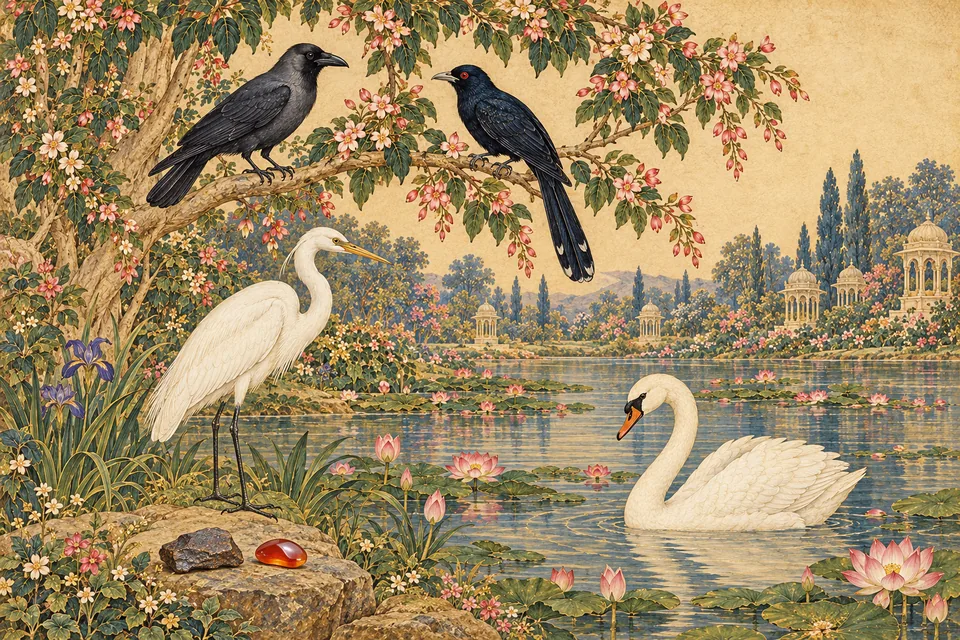
AI-created devotional illustration · Chaupai 3
A crow and koel on a branch above a heron and swan, symbolizing the refining power of good company.
Source reference and artistic choices
Gita Press code81 undated · PDF pages 23, 24 · printed pages 21, 22. Reader passage: bala-kanda-chaupai-003. Printed numbering may differ.
Source facts
- Beneficial company compared to crows becoming cuckoos and herons becoming swans
- Sages Valmiki, Narada and Agastya cited as witnesses to good company's transformative power, without a described joint meeting
- Discernment through good company and Rama's grace; philosopher's stone improves base metal, serpent jewel retains own virtue
Artistic choices
- Four distinct birds placed together symbolically, with no literal metamorphosis
- Invented garden and pond, poses, polished stone and iron fragment
- Small distant garden pavilions are invented setting details, without historical location
An imaginative interpretation, not a historical portrait or documentary evidence.
मज्जन फल पेखिअ ततकाला। काक होहिं पिक बकउ मराला।। सुनि आचरज करै जनि कोई। सतसंगति महिमा नहिं गोई।। बालमीक नारद घटजोनी। निज निज मुखनि कही निज होनी।। जलचर थलचर नभचर नाना। जे जड़ चेतन जीव जहाना।। मति कीरति गति भूति भलाई। जब जेहिं जतन जहाँ जेहिं पाई।। सो जानब सतसंग प्रभाऊ। लोकहुँ बेद न आन उपाऊ।। बिनु सतसंग बिबेक न होई। राम कृपा बिनु सुलभ न सोई।। सतसंगत मुद मंगल मूला। सोइ फल सिधि सब साधन फूला।। सठ सुधरहिं सतसंगति पाई। पारस परस कुधात सुहाई।। बिधि बस सुजन कुसंगत परहीं। फनि मनि सम निज गुन अनुसरहीं।। बिधि हरि हर कबि कोबिद बानी। कहत साधु महिमा सकुचानी।। सो मो सन कहि जात न कैसें। साक बनिक मनि गुन गन जैसें।।
The fruit of bathing in satsang is visible at once. Crows become koels, and herons become swans. Let no one be astonished at this, for the glory of holy company is no secret. Valmiki, Narada, and Agastya (the pot-born sage) each told their own story of transformation with their own lips. Every creature in this world, whether of water, land, or sky, whether inert or aware; whatever wisdom, fame, spiritual progress, prosperity, or goodness anyone has ever gained, anywhere, by any means, all of it traces back to the company of the holy.