Saraswati Turns Manthara's Mind
Ayodhya Kanda, Doha 12
Doha 12 · Movement 2 of 2
Keep this contemplation
Preserve, print, or share
Within Kaikeyi's household lives Manthara, a maid whose understanding is already narrow. Saraswati enters the vulnerable movement of her mind and bends it toward the coming purpose.
The doha names the transformation starkly: Manthara becomes a container of infamy. The goddess then withdraws, leaving the altered thought to travel through human speech and choice.
A cosmic request has reached an ordinary palace servant. Heaven does not descend with thunder or visible command. It works through interpretation, resentment, and words soon to be spoken in private. The immense turn of the epic begins within a mind no one in festive Ayodhya is watching.
The destiny of kingdoms contracts into one altered mind, and Saraswati silently departs.
Read the passage from the Manas
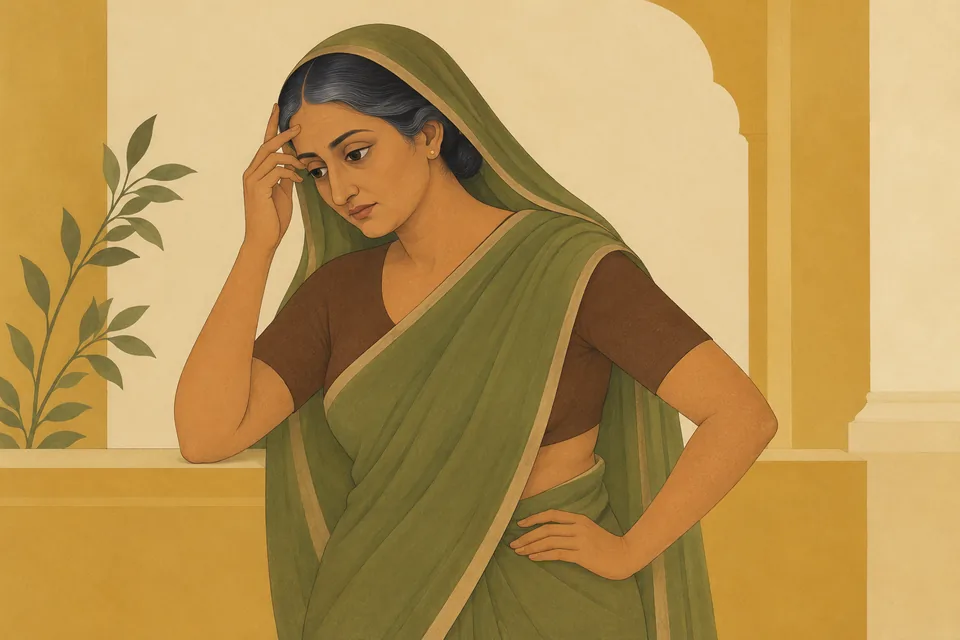
AI-created devotional illustration · Doha 12
A first imagined Manthara portrait at the change in her thinking, while Saraswati's action/departure remain explicit textual facts.
Source reference and artistic choices
Gita Press code81 undated · PDF pages 355 · printed pages 353. Reader passage: ayodhya-kanda-doha-013. Printed numbering may differ.
Source facts
- Manthara is named as Kaikeyi's dull-minded maid. Saraswati/Gira alters her intellect, making her a container of infamy, and leaves; do not substitute Kaikeyi as the maid or altered actor.
- Infamy-container language is moral metaphor, not a literal box or physical transformation; no bodily light effect is narrated.
- The adjacent freshly inspected witness PDF356, printed doha13/stable doha014, explicitly calls Manthara kubari, hunchbacked. This continuity trait is not itself stated in this doha; chosen face, maturity, clothes and exact posture remain imagined.
- Printed doha12 and stable reader doha013 are separately retained. Later city inquiry and speech/tears to Kaikeyi belong to chaupai013.
Artistic choices
- First imagined mature Manthara appearance: warm medium-brown weathered angular oval/brown eyes/broad rounded nose/thin lips, black-silver low bun, plain olive/sand veil-sari and brown blouse, tiny earrings; no authenticated likeness or exact age asserted.
- Exact temple/waist hands and service alcove are art staging; adjacent source kubari trait informs continuity without equating physical condition with moral conduct.
- Complete source facts retained in metadata; source and existing translations unchanged.
- Actual temple/waist hands, weathered mature facial convention/gray hair, plain olive-brown clothes, forward-inclined posture and service alcove are first imagined appearance and staging; no authenticated likeness, numerical age or physical cause of moral conduct asserted.
An imaginative interpretation, not a historical portrait or documentary evidence.
नामु मंथरा मंदमति चेरी कैकेइ केरि। अजस पेटारी ताहि करि गई गिरा मति फेरि।।12।।
Her name was Manthara, a dull-witted cheree (maidservant) of Kaikeyi. Giraa (the goddess of speech, Saraswati) turned her mind and made her an ajas petaaree (a box of infamy), then departed.