Manthara Wraps Her Warning in Wounded Loyalty
Ayodhya Kanda, Chaupai 16
Doha 16 · Movement 1 of 2
Keep this contemplation
Preserve, print, or share
Manthara pretends that Kaikeyi punishes honesty and prefers pleasing lies. She laments her own ugliness and helpless station, claiming that whoever becomes king can bring no gain or loss to one born a servant.
Then she recasts malice as sacrifice. Her nature deserves burning, she says, only because she cannot bear to watch the queen's ruin. The few harmful words become, in her account, reluctant service offered for Kaikeyi's welfare.
Flattery, self accusation, and wounded loyalty weave together. Manthara makes resistance look like cruelty and suspicion look like gratitude. By asking forgiveness for a supposed blunder, she draws the queen toward requesting the poison again.
Manthara disguises the blade as wounded devotion and waits for Kaikeyi to ask that it be uncovered.
Read the passage from the Manas
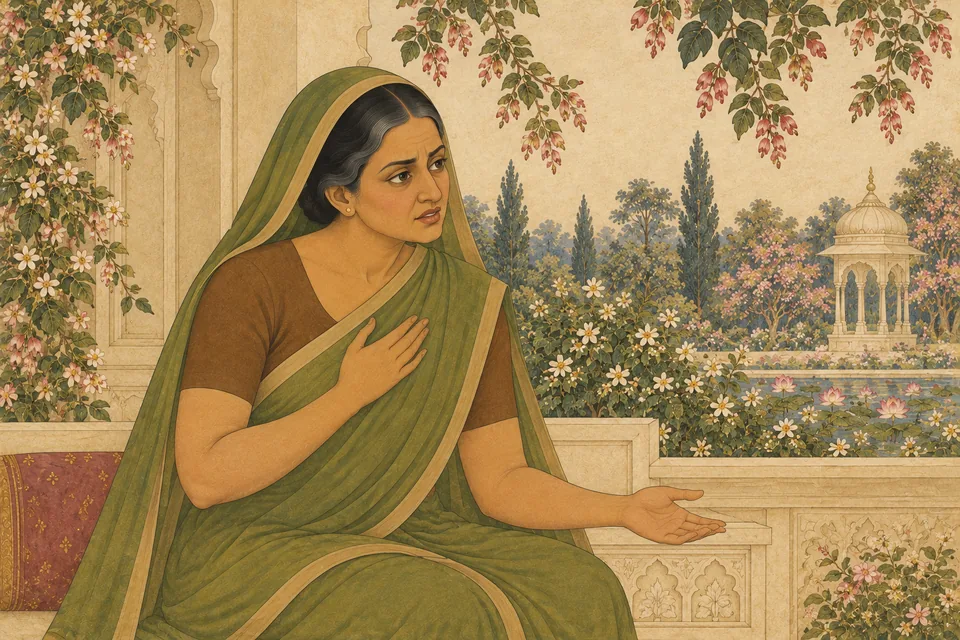
AI-created devotional illustration · Chaupai 16
Manthara rhetorically apologizes and says she cannot bear seeing Kaikeyi's harm; queen offcrop, all eight source parts retained as attributed speech.
Source reference and artistic choices
Gita Press code81 undated · PDF pages 358, 359 · printed pages 356, 357. Reader passage: ayodhya-kanda-chaupai-016. Printed numbering may differ.
Source facts
- 1–2: Manthara sarcastically says all her hopes were fulfilled at once, that further speech would need a second tongue, and her unfortunate head deserves breaking because even good words distress the queen. These are rhetorical speech, not actual second tongue or enacted injury.
- 3–4: She complains fabricated true/false words please Kaikeyi while she is bitter, and says she will flatter or keep silent day and night. Preserve her speech attribution.
- 5–6: She describes herself as made ugly and dependent by providence, invokes reaping what is sown/receiving what given, says any king brings her no loss because she remains a maid rather than becoming queen. These self-descriptions are not endorsed judgments linking appearance and morals.
- 7–8: She says her nature deserves burning and she cannot see Kaikeyi's harm, which led her to offer pertinent counsel, then asks goddess-like queen to forgive her great mistake. Rhetorical self-abasement, not burning or self-harm action.
- All eight source couplets across PDF358–359 retained. Historical concluding metered actor/action drift and displaced Hindi citizens/ferryman/Ashoka site remain unresolved without corpus change.
Artistic choices
- Exact apologetic speech expression, one hand at own chest and one low relaxed explaining palm are imagined staging; no injury or literal metaphor enacted.
- Accepted Manthara appearance retained without equating physical condition with moral conduct; fine botanical palace garden in E02 is imaginary setting.
- Complete source facts retained in metadata; source and existing translations unchanged.
- Actual fine floral boughs, palace garden/pond/pavilion, ledge/pillow and chest/palm gestures are imagined narrative staging.
An imaginative interpretation, not a historical portrait or documentary evidence.
एकहिं बार आस सब पूजी। अब कछु कहब जीभ करि दूजी।। फोरै जोगु कपारु अभागा। भलेउ कहत दुख रउरेहि लागा।। कहहिं झूठि फुरि बात बनाई। ते प्रिय तुम्हहि करुइ मैं माई।। हमहुँ कहबि अब ठकुरसोहाती। नाहिं त मौन रहब दिनु राती।। करि कुरूप बिधि परबस कीन्हा। बवा सो लुनिअ लहिअ जो दीन्हा।। कोउ नृप होउ हमहि का हानी। चेरि छाड़ि अब होब कि रानी।। जारै जोगु सुभाउ हमारा। अनभल देखि न जाइ तुम्हारा।। तातें कछुक बात अनुसारी। छमिअ देबि बड़ि चूक हमारी।।
All my hopes were fulfilled at once, but now I must speak with a different tongue. This wretched head of mine deserves to be broken, for even good words cause you pain. Those who speak lies and weave false tales are dear to you, while I, O mother, am made the villain. I too shall now speak only flattery to please my master; otherwise I will keep silent day and night. The Creator made me ugly and helpless. One must reap whatever He has sown. Whoever becomes king, what loss is it to me? A servant I was born; can I ever become a queen? My very nature deserves to be set ablaze, for I cannot bear to watch your ruin. That is why I spoke a few words in your interest. Forgive me, O Queen, for my great blunder.