Kausalya Prays for Ram's Welfare at Every Shrine
Ayodhya Kanda, Chaupai 8
Doha 8 · Movement 1 of 2
Keep this contemplation
Preserve, print, or share
Messengers who bring the news receive ornaments and garments, while loving hands arrange auspicious vessels. Sumitra fills courtyards with jeweled designs, giving joy visible pattern beneath every approaching footstep.
Kausalya summons learned priests and gives generous offerings. She worships village deities, gods, and serpent guardians, promising further offerings while asking only that Ram's welfare be secured.
Women with cuckoo sweet voices and moon bright faces sing songs of blessing. Yet beneath the splendour, a mother's prayer remains simple and protective. The crown may belong to the kingdom, but Kausalya approaches every sacred power as one who still sees the child whose safety is dearer than royalty.
Across every shrine, Kausalya asks not for splendour but for the welfare of her son.
Read the passage from the Manas
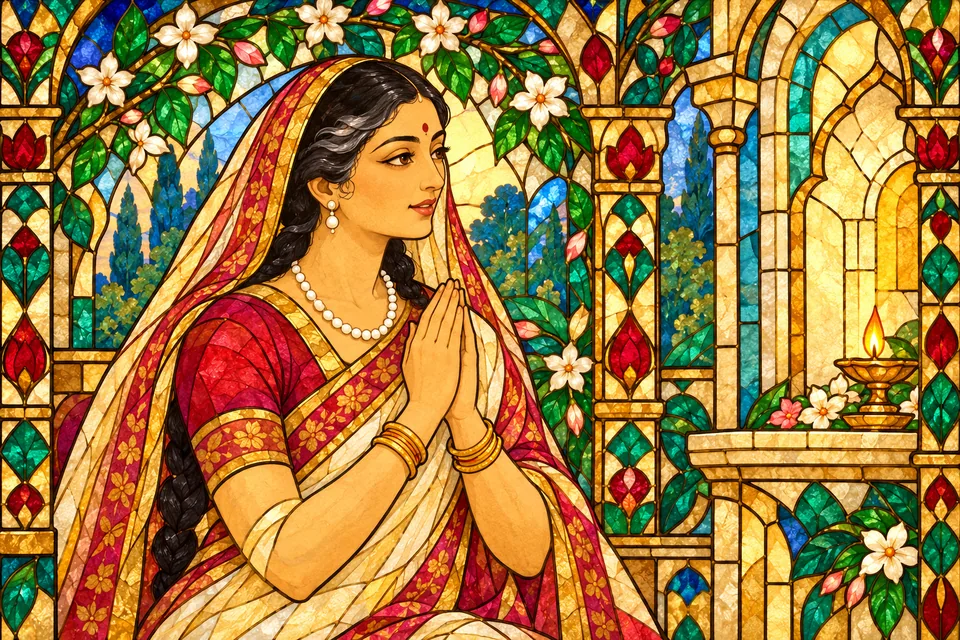
AI-created devotional illustration · Chaupai 8
Kaushalya prays for Rama's welfare; all seven source units, including Sumitra's decorating and the collective preparations, retained in full.
Source reference and artistic choices
Gita Press code81 undated · PDF pages 351, 352 · printed pages 349, 350. Reader passage: ayodhya-kanda-chaupai-008. Printed numbering may differ.
Source facts
- 1: Those who first bring the news receive abundant ornaments and garments as gifts. No named first messenger is supplied.
- 2: Bodies thrill with love and minds are affectionate; all the women begin decorating auspicious kalash vessels.
- 3: Sumitra fills/decorates beautiful courtyards with many lovely jeweled designs. Do not transfer Sumitra's actor role to Kaushalya.
- 4: Rama's mother, immersed in joy, calls Brahmins and gives many gifts. The printed Hindi identifies this mother as Kaushalya.
- 5: She worships the unnamed village goddess, gods and Nagas and says she will offer their bali portion again; no particular village goddess icon or identity is named.
- 6: She prays that by their grace they grant whatever blessing brings Rama's welfare. This is the selected prayer moment, not a completed royal anointing.
- 7: Women sing auspicious songs; cuckoo voices, moon faces and fawn eyes are literary comparisons, not animal or lunar bodily parts.
- Foreign Hindi about Lakshmana's farewell and Nishada meeting Shatrughna is not adopted into this scene; original source and translation fields remain unchanged.
Artistic choices
- Exact namaste, speaking expression, inherited Kaushalya garments/jewels, waist-up crop and abstract palace alcove are art staging.
- All seven units are retained; Sumitra's distinct role and unnamed deity recipients are not replaced or given invented portraits.
- Complete source facts retained in metadata; source and existing translations unchanged.
- Actual small lit brass-colored lamp with flowers on an empty alcove shelf, exact speaking expression/namaste and jeweled floral architecture are devotional art staging, not a specified source lamp or invented goddess identity.
An imaginative interpretation, not a historical portrait or documentary evidence.
प्रथम जाइ जिन्ह बचन सुनाए। भूषन बसन भूरि तिन्ह पाए।। प्रेम पुलकि तन मन अनुरागीं। मंगल कलस सजन सब लागीं।। चौकें चारु सुमित्राँ पुरी। मनिमय बिबिध भाँति अति रुरी।। आनँद मगन राम महतारी। दिए दान बहु बिप्र हँकारी।। पूजीं ग्रामदेबि सुर नागा। कहेउ बहोरि देन बलिभागा।। जेहि बिधि होइ राम कल्यानू। देहु दया करि सो बरदानू।। गावहिं मंगल कोकिलबयनीं। बिधुबदनीं मृगसावकनयनीं।।
Those who first went and announced the blessed news received abundant ornaments and fine garments as their reward. Their bodies thrilled with love and their hearts overflowed with devotion; everyone began arranging auspicious vessels and decorations. Sumitra filled the beautiful courtyards with jeweled designs of many kinds, each more lovely than the last. Rama's mother, lost in bliss, summoned many learned priests and gave them generous offerings. She worshipped the village deities, the gods, and the serpent guardians, and vowed to bring them their share of sacred offerings once more. She prayed: "By whatever means Rama's welfare may be ensured, please grant that boon with your compassion." Women with cuckoo-sweet voices, moon-bright faces, and eyes gentle as a fawn's sang auspicious songs of celebration.