White Hair Beside the Crown
Ayodhya Kanda, Chaupai 2
Doha 2 · Movement 1 of 2
Keep this contemplation
Preserve, print, or share
The royal court of Ayodhya stands in ordered splendour. Kings, ministers, guardians, and elders fill the pillared hall while Dasharatha sits beneath the white canopy of the Raghus. Reports of Ram's fame move through the assembly, and joy rises in the old king with each word. Across the three worlds, Tulsidas says, no father is more fortunate than the one whose son is the root of all auspiciousness.
In an unguarded moment, Dasharatha lifts a mirror. He looks upon his face and straightens the crown. Gold settles again above his brow, but near his ears a few white hairs have appeared. The court continues around him, unaware that time has entered the hall in silence and taken its place beside the throne.
The pale strands carry counsel more penetrating than ceremony. Crown Ram as Yuvaraja. Receive the true fruit of this life while breath remains. The king lowers the mirror, and what began as a small gesture becomes the turning of Ayodhya's destiny.
The crown is straight, but the white hairs have spoken.
Read the passage from the Manas
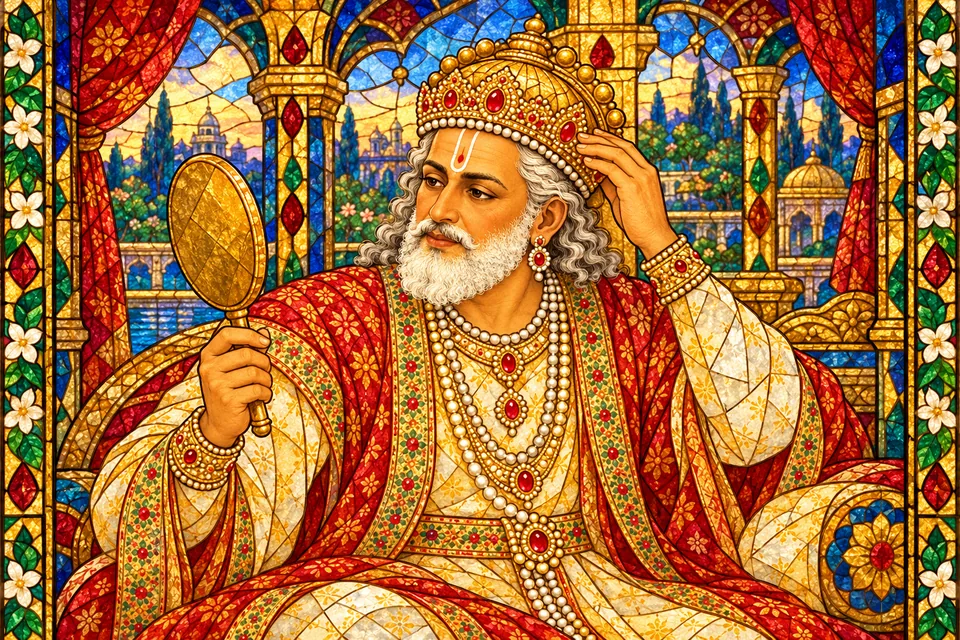
AI-created devotional illustration · Chaupai 2
Dasharatha takes a mirror, looks at his face and straightens his crown; all eight source units retained.
Source reference and artistic choices
Gita Press code81 undated · PDF pages 347 · printed pages 345. Reader passage: ayodhya-kanda-chaupai-002. Printed numbering may differ.
Source facts
- 1: Once the Raghu king Dasharatha sits in royal assembly with all his company.
- 2: King embodies all good deeds and is greatly delighted hearing Rama's good fame.
- 3: All kings desire his grace; WORLD-GUARDIANS love him while keeping regard for his disposition/wishes, not ordinary subjects substituted.
- 4: Across three worlds and three times none has great fortune equal to Dasharatha.
- 5: His son Rama is the root of auspiciousness; whatever praise is said of him is little.
- 6: King naturally takes a mirror in his hand, looks at his face and straightens his crown. Not making his face shine.
- 7: White hairs have appeared near ears, as if old age gives this instruction; it is a personifying comparison, not an actual age apparition.
- 8: O king, give Rama crown-prince rank and take profit of life and birth; inner age-counsel comparison, no actual coronation here.
- Existing Hindi includes foreign Janaka/Rama societies bathing; metred/coupled layers substitute subjects/world-guardians and face shining/crown straightening. Corpus unchanged; exact source action selected.
Artistic choices
- Mirror oval shape, plain gold back and short handle, precise seated arm positions, court pavilion, clothes and jewels are artist choices. Reflection is hidden by the mirror angle; source still states he looks at his face.
- Established gray-white elder appearance retained as art convention, no precise first-onset aging portrait or physical personified old age claimed.
- Complete source facts retained in metadata; source and existing translations unchanged.
- Actual gold floral royal chair, curtains and jeweled palace/river background are imaginative court staging. Mirror back facets and crown rim gesture are artist specifics, not source manufacturing or exact geometry certification.
An imaginative interpretation, not a historical portrait or documentary evidence.
एक समय सब सहित समाजा। राजसभाँ रघुराजु बिराजा।। सकल सुकृत मूरति नरनाहू। राम सुजसु सुनि अतिहि उछाहू।। नृप सब रहहिं कृपा अभिलाषें। लोकप करहिं प्रीति रुख राखें।। तिभुवन तीनि काल जग माहीं। भूरि भाग दसरथ सम नाहीं।। मंगलमूल रामु सुत जासू। जो कछु कहिज थोर सबु तासू।। रायँ सुभायँ मुकुरु कर लीन्हा। बदनु बिलोकि मुकुट सम कीन्हा।। श्रवन समीप भए सित केसा। मनहुँ जरठपनु अस उपदेसा।। नृप जुबराज राम कहुँ देहू। जीवन जनम लाहु किन लेहू।।
One day, the king of the Raghus sat in his royal court with his entire assembly gathered around him. The king, the very embodiment of all virtuous deeds, felt immense joy hearing the glorious fame of Rama. All other kings lived in hope of his grace, and the guardians of the world honored his wishes with love. In all three worlds and throughout all time, there is no one as fortunate as King Dasharatha. He whose son is Rama, the very root of all blessing: whatever praise one offers of such a father falls short. The king, quite naturally, picked up a mirror and, gazing at his face, straightened his crown. White hairs had appeared near his ears, as if old age itself were giving this counsel: "O King, bestow the crown-prince title upon Rama. Why not reap the true reward of this life and this birth?"